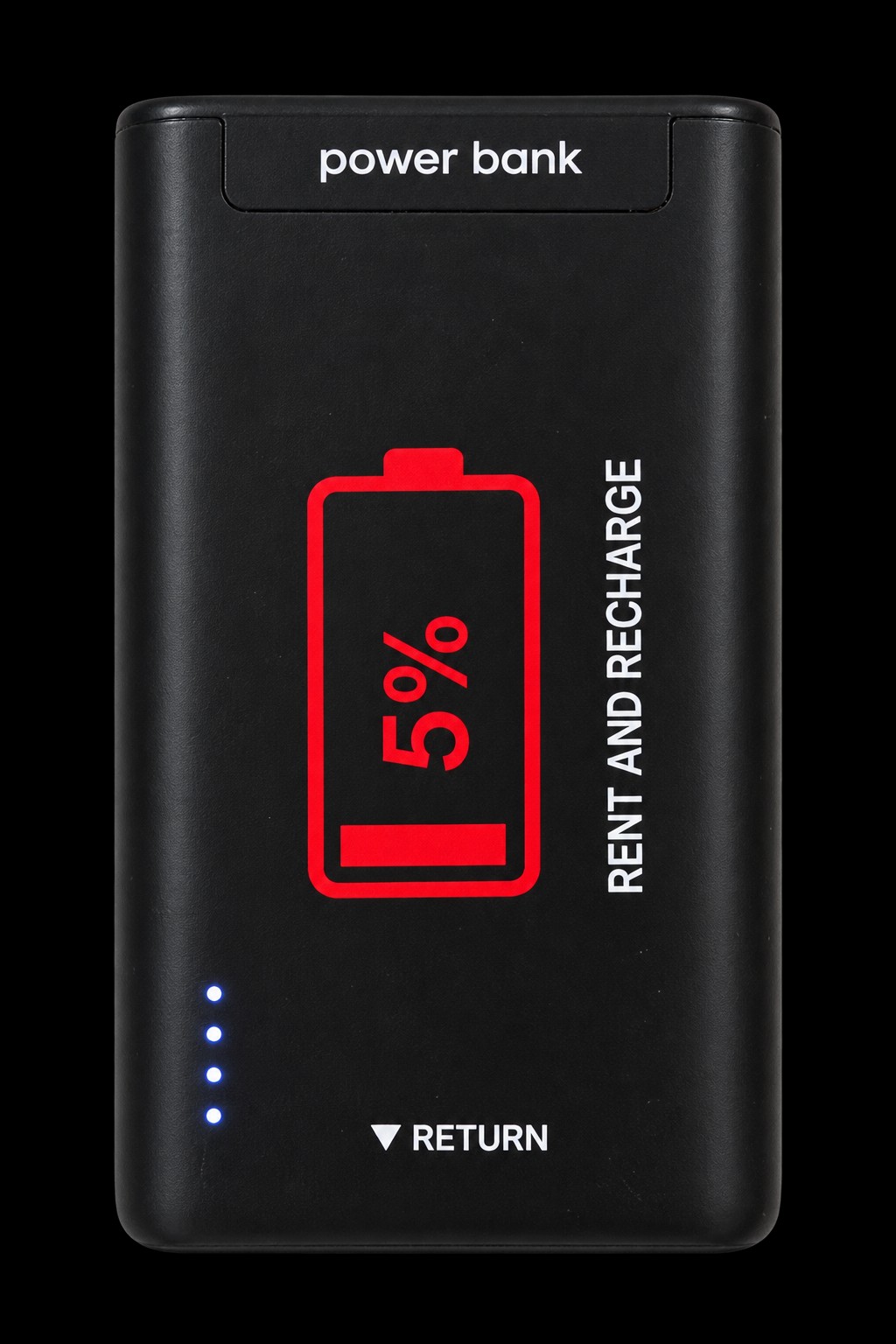
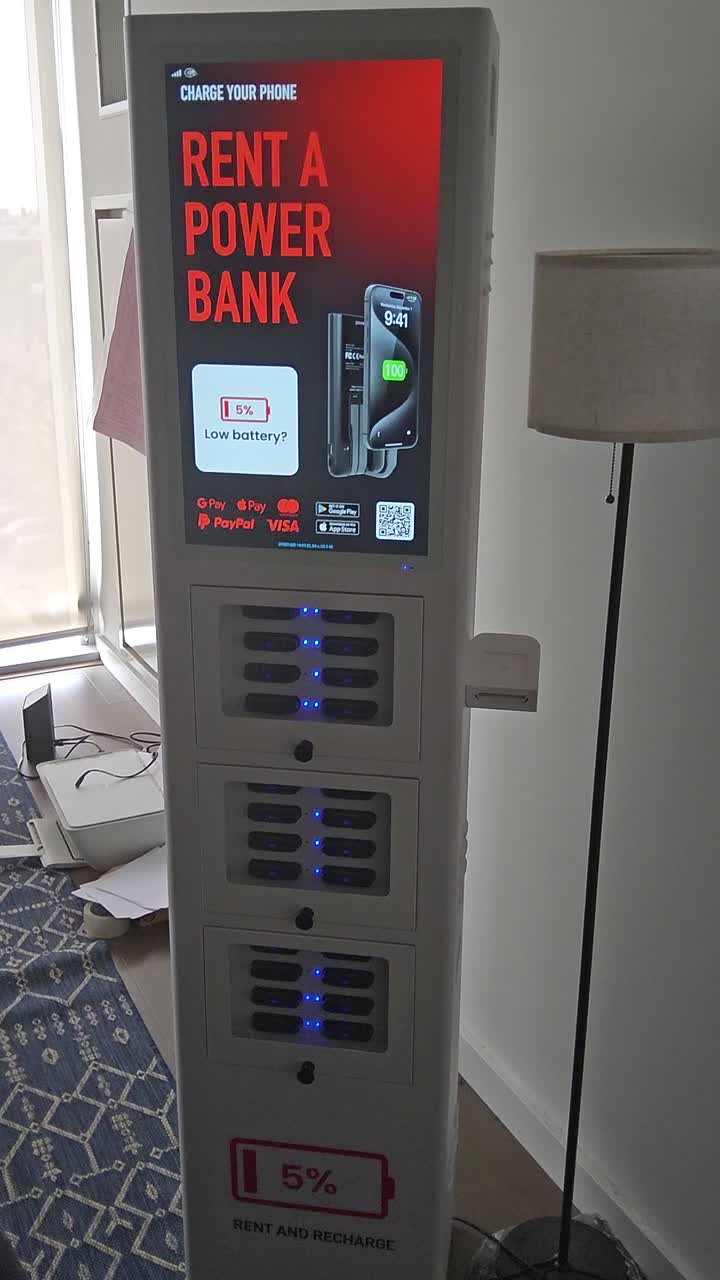
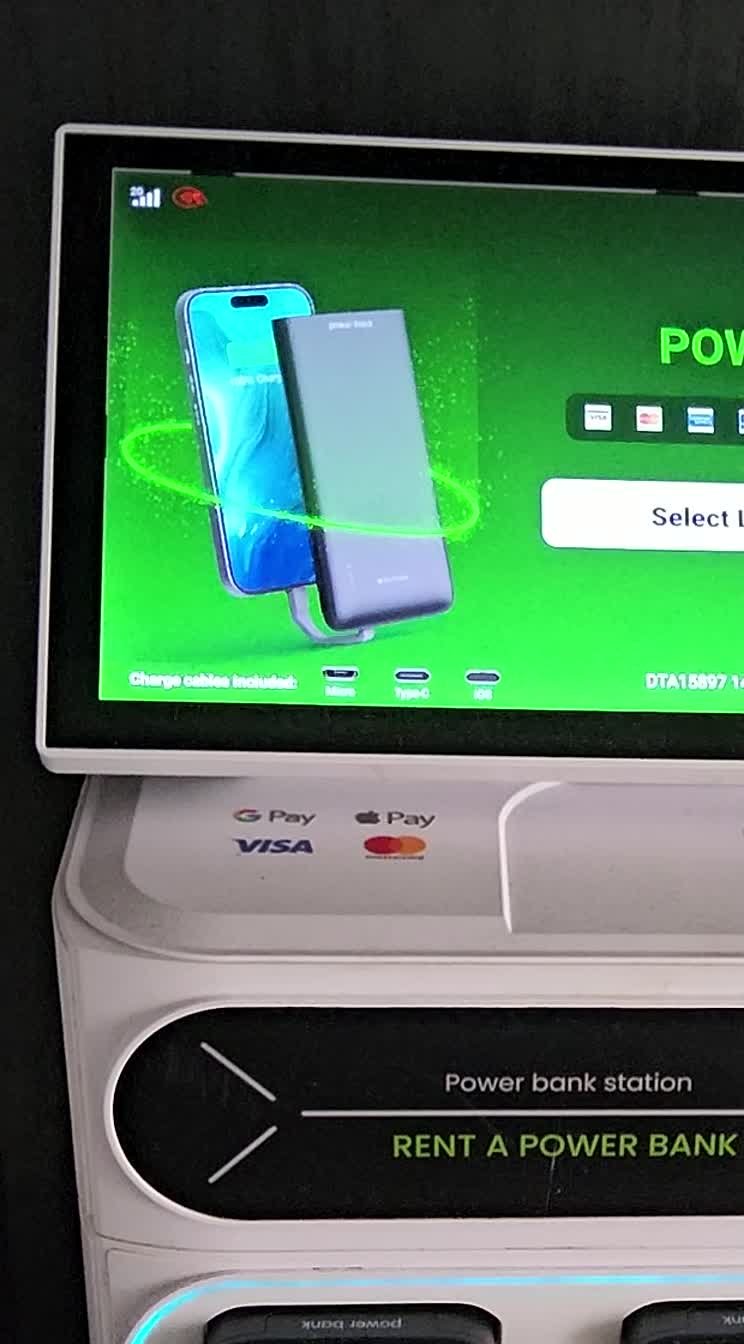
A power bank rental model built for festivals, seasonal venues and permanent locations.
One 24-bank customer-facing tower, 76 reserve banks, and a flexible deployment strategy that favors revenue share over fixed rent.
The simple daily math
Each example assumes 100 two-hour rentals in one operating day - one paid rental per bank.
A lower-cost example can be $1 + $1 + $1 = $3.
A $1 release fee plus $1 for each of two hours creates a $3 two-hour rental. This separates the affordable rental price from the separate question of how the operator protects the power bank if a customer cannot support a large card hold.
24 banks in the tower is a different model.
An unattended permanent location does not have an event operator continuously adding charged reserve banks. One complete turn of the 24 banks produces $168, $192, or $216 at the $7, $8, or $9 two-hour price. Those figures are a one-turn baseline, not a hard daily cap: returned and recharged banks can rent again.
One season can potentially repay the investment.
The examples below use 80 Friday-Sunday event days, a 20% venue share and $150/day staffing for attended events. The 24-rental permanent-location example has no event employee. These are illustrative contribution calculations, not guaranteed profit.
| Event volume | Rental math | Contribution / day* | Equipment payback | Season result |
|---|---|---|---|---|
| 100 rentals/day | $3 + $2 + $2 = $7 | $410 | $8,760 in 22 days | $24,040 after equipment |
| 100 rentals/day | $4 + $2 + $2 = $8 | $490 | $8,760 in 18 days | $30,440 after equipment |
| 100 rentals/day | $5 + $2 + $2 = $9 | $570 | $8,760 in 16 days | $36,840 after equipment |
| 50 rentals/day | $3 + $2 + $2 = $7 | $130 | $8,760 in 68 days | $1,640 after equipment |
| 50 rentals/day | $4 + $2 + $2 = $8 | $170 | $8,760 in 52 days | $4,840 after equipment |
| 50 rentals/day | $5 + $2 + $2 = $9 | $210 | $8,760 in 42 days | $8,040 after equipment |
*After the example 20% venue share and $150/day staffing; before payment processing, transportation, insurance, repairs, taxes and other costs.
Twenty-four rentals can still make money because there is no event employee.
A hotel or other permanent unattended location is a different model. If the 24 banks each rent once, gross daily rental revenue is $168, $192, or $216. With no site revenue share, an $8,000 tower reaches simple rental-revenue payback in about 48, 42, or 38 operating days. With a 20% site share, the examples become about 60, 53, or 47 days.
The product solves an emergency, not just a charging preference.
The need often appears when the phone is already dying. Buying another cord still requires a place to plug it in. A rentable power bank lets the customer keep moving while charging — useful at hotels, events, travel hubs, entertainment venues and anywhere people are away from their normal charger.
One tower is only the starting point.
The event example is one tower for one May-through-October season. At the same 100-rentals-per-tower-per-day assumption, adding towers multiplies the gross opportunity.
| Towers | Event equipment | $7 season | $8 season | $9 season |
|---|---|---|---|---|
| 1 | $8,760 | $56,000 | $64,000 | $72,000 |
| 2 | $17,520 | $112,000 | $128,000 | $144,000 |
| 3 | $26,280 | $168,000 | $192,000 | $216,000 |
| 4 | $35,040 | $224,000 | $256,000 | $288,000 |
| 5 | $43,800 | $280,000 | $320,000 | $360,000 |
Gross arithmetic scenarios before staffing, venue share, processing, transportation, insurance, taxes, repairs and other costs.
The screen can out-earn the charging rental.
With up to 10 advertising positions per tower, 10 advertisers at $200 each equal $2,000 per tower per day. At $300 each, the same inventory is $3,000. Advertising should be matched to the event audience rather than sold randomly.
| Towers | 10 ads x $200 | 10 ads x $300 | $7 rentals* | Combined at $200 ads |
|---|---|---|---|---|
| 1 | $2,000 | $3,000 | $700 | $2,700 |
| 2 | $4,000 | $6,000 | $1,400 | $5,400 |
| 3 | $6,000 | $9,000 | $2,100 | $8,100 |
| 4 | $8,000 | $12,000 | $2,800 | $10,800 |
*100 paid rentals per tower at $3 release + $2 + $2 = $7. Advertising assumes all 10 positions sell. Illustrative only.
Now extend those small daily ad prices from May through October.
This uses the same 80 Friday-Sunday operating days. It assumes all 10 advertising positions are sold on every tower every operating day, with no advertising discount.
| Towers | Ads/day 10 x $200 | 80-day ads @ $200 | Ads/day 10 x $300 | 80-day ads @ $300 |
|---|---|---|---|---|
| 1 | $2,000 | $160,000 | $3,000 | $240,000 |
| 2 | $4,000 | $320,000 | $6,000 | $480,000 |
| 3 | $6,000 | $480,000 | $9,000 | $720,000 |
| 4 | $8,000 | $640,000 | $12,000 | $960,000 |
| 5 | $10,000 | $800,000 | $15,000 | $1,200,000 |
Half-sold example: 5 advertisers x $200 x 80 days = $80,000 of advertising gross on one tower. One tower with 100 daily $7 rentals adds $56,000 of seasonal rental gross, making the fully sold $200-ad example $216,000 combined gross before expenses. These are illustrative arithmetic scenarios, not guaranteed earnings.
Basic or Advanced
Every result updates instantly. There is no Calculate button.
Basic assumptions
Event preset starts with 100 banks and 100 rentals/day. Permanent preset starts with 24 banks and 24 rentals/day; increase rentals/day only when actual returns and recharge cycles support additional turns.
Basic results
*Before processing, transportation, insurance, repairs, taxes and other unselected costs.
Advanced assumptions
Advertising assumptions
Example: 10 advertisers x $200 = $2,000 advertising per tower per day. A 12.5% discount models a four-tower $700 package instead of $800 for one advertiser buying all four at $200 each.
Advanced results
*Illustrative contribution, not guaranteed profit or net income.
The tower holds 24. The business needs reserve inventory.
At a large event, 24 banks can be gone quickly. Some renters may keep a bank for hours or even into the next day, while returned banks may need more than two hours to recharge. The extra 76 banks create a reserve pool that can be charged and rotated into service.
The backup plan I discovered on my last night in China.
Across two trips, I spent almost 90 days in China. I did not originally go there looking for power-bank rentals. I was investigating large automated food machines, including pizza vending equipment and compartment-style hot-food machines. After running into uncertainty around licensing that concept in Chicago, I needed a backup opportunity.
On the last night of one trip, a woman I had gone to eat with came back carrying a rented power bank. I had already seen the large rental stations around town, including machines with English instructions, but I had not watched someone rent one, so I had not understood what they were. That moment changed what I was looking at. I later returned to China specifically to investigate the power-bank opportunity and suppliers.
The lesson is that small, unfamiliar business opportunities can be easy to overlook. A productive permanent tower can stay in place; a seasonal tower can be picked up when the season ends; and an event tower can follow high-traffic weekends. Chicago's May-October season is only one example — indoor events and warmer markets can extend the model throughout the year.